

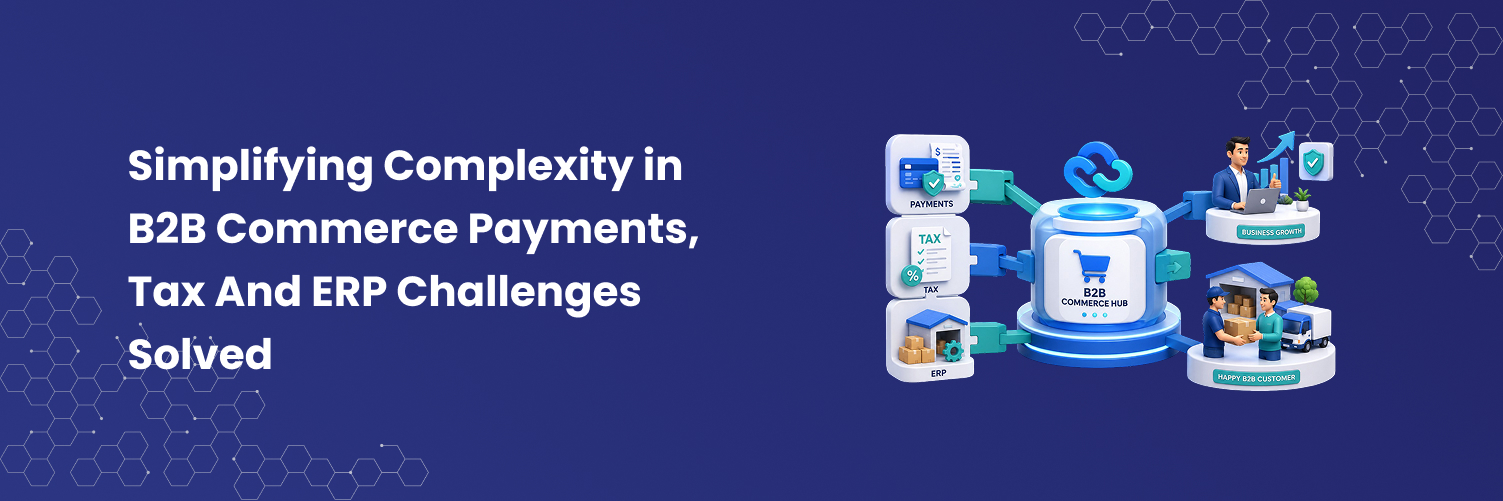
B2B commerce is evolving faster than most organisations can adapt. Buyers who are accustomed to one-click consumer experiences now bring those expectations into their business purchasing they want the same speed, clarity, and convenience from a wholesale portal that they get from a consumer app.
The problem is that behind every B2B transaction sits a layer of complexity that simply doesn't exist in B2C. Customer-specific pricing, negotiated payment terms, invoice-based purchasing, multi-jurisdiction tax compliance, exemption certificates, and ERP-connected workflows all need to work seamlessly simultaneously, at scale, across every channel your business sells through.
This guide breaks down the three biggest operational challenges facing modern B2B commerce payments, tax compliance, and system consistency and explains exactly how Shopware's platform and Mavenbird's implementation expertise help you solve each one.
Why B2B Commerce Is Fundamentally Different
Unlike B2C, where the primary goal is to inspire a purchase, B2B transactions are rooted in business processes, compliance requirements, and operational efficiency. A B2B buyer isn't browsing they're procuring. They need the right product, at the right price, through the right payment method, with the right tax treatment applied automatically. Every time. Without exceptions.
This is why successful B2B commerce extends far beyond the storefront. It requires tight coordination between your commerce platform, payment providers, tax engines, ERP systems, and customer service processes all delivering a consistent experience regardless of which channel a buyer uses.
The Three Biggest Operational Challenges in B2B Commerce
B2B payment needs go far beyond credit cards ACH, company credit limits, invoice terms, partial payments, and ERP-connected workflows all need to work inside your commerce portal.
Economic nexus, product taxability, and exemption certificate management are all more complex in B2B and the consequences of errors are larger because transaction values are higher.
Whether a customer orders through your portal, a sales rep, EDI, or customer service, the same pricing, payment rules, and tax calculations must apply or trust breaks down.
B2B Payment Complexity What Your Commerce Platform Must Handle
Modern B2B organisations need payment infrastructure that goes far beyond what was built for consumer transactions. The most common B2B payment requirements that a commerce platform must support include:
ACH bank transfers
Company-level credit limits
Invoice-based purchasing
Partial invoice payments
ERP-connected workflows
Multiple payment methods per account
Invoice viewing & payment in portal
Purchase order integration
Many B2B organisations want customers to view and pay invoices directly through their commerce portal without switching between the webshop and a separate billing system. This requires deep integration between the ecommerce platform and the ERP environment behind it.
Level 2 & Level 3 Processing The Hidden Margin Opportunity
One of the most significant and most overlooked opportunities in B2B payments is Level 2 and Level 3 processing. Most B2B organisations are leaving meaningful money on the table by not taking advantage of it.
Passes additional order data to card networks, qualifying B2B transactions for lower interchange rates.
- Invoice number
- Tax amount
- Customer code / PO number
- Merchant tax ID
Provides complete line-item data per transaction, unlocking the lowest interchange rates available for commercial cards.
- SKU / item description per line
- Quantity and unit price
- Freight amount
- Discount per line item
For organisations processing millions of dollars annually, a saving of even 40 basis points translates directly into significant, recurring improvements in profitability without changing a single product price or customer rate.
Surcharging Protecting Margins Without Raising Prices
For B2B distributors and wholesalers operating on thin margins (often 5–7%), recovering even a portion of payment processing costs through surcharging can have a meaningful financial impact. Surcharging allows merchants to pass a portion of credit card processing fees to customers who choose to pay by card an increasingly accepted practice in the B2B space, particularly for buyers who have alternative payment methods available.
Global Payment Optimisation
As B2B companies expand internationally, payment orchestration becomes critical. A payment process that works well in one market may result in lower authorisation rates or failed transactions in another frustrating buyers and creating revenue leakage that's easy to miss until it accumulates. Global payment infrastructure should support international expansion rather than create barriers to it.
B2B Tax Compliance Why Accuracy Matters More Than in B2C
Tax mistakes in B2B commerce carry higher consequences than in B2C because transaction values are significantly larger. An inaccurate tax calculation on a £50 consumer purchase is a minor inconvenience. The same error on a £50,000 wholesale order can lead to delayed fulfilment, manual corrections, compliance risk, and potentially lost future business.
The goal is simple: tax should work correctly, seamlessly, in the background every time, without requiring your team to manually intervene.
The 2018 US Supreme Court decision in South Dakota v. Wayfair established that states can require businesses to collect sales tax based on revenue or transaction volume even with no physical presence in that state. Today, every US state with a sales tax has economic nexus laws in place, creating compliance obligations that many B2B sellers are still unaware of.
The Three Tax Complexity Areas That Catch B2B Sellers Out
Different product categories tangible goods, digital products, services, food, apparel, software are taxed differently across jurisdictions. Even within the same category, exemptions and special rules vary by state and country. The wrong tax code classification leads to over-collection, under-collection, or compliance issues all of which create problems that grow with scale.
Wholesale buyers often expect to purchase tax-free immediately upon account opening. But most B2B organisations still rely on manual certificate collection spreadsheets, email attachments, physical forms that introduce delays, buyer frustration, and audit risk. Modern tax automation captures certificates digitally, validates exemption status in real time, and maintains audit-ready documentation automatically.
A B2B organisation selling across multiple US states, or internationally, faces a matrix of tax rules that is simply impossible to manage accurately by hand. Tax rates change, thresholds shift, and new regulations emerge continuously. Automated tax engines that update in real time are the only scalable solution for organisations operating across more than a handful of jurisdictions.
System-Wide Consistency The Foundation of B2B Trust
One of the most important and most overlooked principles of B2B commerce is consistency. A B2B buyer who places an order through your online portal, then calls a sales rep to amend it, then checks order status through your ERP-connected customer service team expects to see the exact same pricing, the exact same payment options, and the exact same tax treatment every single time, regardless of which channel they used.
When consistency breaks down when a price available online differs from what a rep can offer, or when tax calculations vary by channel trust erodes. And in B2B, where relationships and repeat orders drive the majority of revenue, trust is everything.
Every one of these channels should apply the same payment rules, the same tax calculations, the same pricing structures, and the same customer permissions. This consistency requires a single source of truth at the platform level which is exactly what Shopware's B2B Components and API-first architecture are designed to provide.
We configure Shopware's full B2B Suite company hierarchies, role and rights management, customer-specific pricing, budget controls, quick order entry, and contact management tailored to your exact business model.
We design and implement your B2B payment stack in Shopware ACH, company credit limits, invoice purchasing, partial payments, Level 2/3 data enrichment, and surcharging connected to your existing payment providers and ERP environment.
We connect automated tax compliance systems to your Shopware store providing real-time nexus monitoring, product taxability mapping, digital exemption certificate management, and audit-ready documentation at the scale your B2B operation demands.
We build the integration layer between Shopware and your ERP, warehouse management, and CRM systems ensuring orders, inventory, customer data, pricing rules, and invoices stay synchronised across your entire technology stack in real time.
Before launch, we audit every sales channel portal, EDI, sales rep tools, customer service workflows to confirm that pricing, payment, and tax rules are applied consistently. Inconsistencies are resolved at the architecture level, not patched per channel.
B2B commerce requirements evolve new customer accounts, new markets, new payment arrangements. Our retainer support keeps your Shopware B2B platform aligned with your business as it grows, with certified Shopware developers available on a structured SLA.
Frequently Asked Questions
Why is B2B commerce more operationally complex than B2C?
B2B transactions involve customer-specific pricing, negotiated payment terms (net-30, net-60), invoice-based purchasing, company credit limits, tax exemption certificates, ERP integration, and compliance requirements that simply don't exist in consumer commerce. Each B2B order may have different rules depending on the customer account, jurisdiction, product type, and payment method all of which must be applied correctly and consistently across every channel.
What is Level 2 and Level 3 payment processing and why does it matter?
Level 2 (L2) and Level 3 (L3) processing provide additional order data invoice details, tax amounts, SKU information, purchase order data to card networks during B2B transactions. Because this data reduces transaction risk, Visa and Mastercard offer lower interchange rates for qualifying transactions, typically saving 10 to 90 basis points per transaction. For organisations processing millions annually, this creates substantial ongoing savings. Mavenbird implements L2/L3 data enrichment as part of B2B payment integration for Shopware stores.
What is economic nexus and why should B2B sellers care?
Economic nexus is a requirement, established by the 2018 US Supreme Court decision in South Dakota v. Wayfair, that businesses collect sales tax in states where they exceed revenue or transaction volume thresholds even without a physical location in that state. All 45 US states with a sales tax now have economic nexus laws. Many B2B sellers are unaware that wholesale transactions, marketplace sales, and multi-channel selling all count toward these thresholds, creating compliance obligations that can surface as significant liabilities during audits.
How does Shopware handle B2B payment complexity?
Shopware's open, API-first architecture allows integration with any payment provider including those specialising in B2B payment types like ACH, company credit limits, and invoice purchasing. Shopware's native B2B Components also support customer-specific pricing, account hierarchies, and purchase order workflows. Mavenbird designs and implements the full B2B payment stack for Shopware, connecting payment providers, ERP systems, and tax engines into a unified customer experience.
What does Mavenbird deliver for Shopware B2B projects?
Mavenbird handles the full Shopware B2B implementation configuring B2B Components (company hierarchies, pricing, roles), integrating B2B-optimised payment providers (ACH, invoicing, credit limits, L2/L3 data), connecting tax compliance engines (nexus monitoring, exemption certificates), building ERP integrations, and ensuring multi-channel consistency. We provide phased delivery, regular demos, and long-term retainer support for ongoing B2B platform evolution.
How long does a Shopware B2B implementation take?
A standard Shopware B2B store with B2B Components, payment integration, and basic ERP connectivity typically takes 12–20 weeks from kick-off to go-live. More complex projects with custom pricing engines, multiple ERP integrations, full tax automation, or headless frontends may take 20–32 weeks. Mavenbird provides a detailed project timeline following an initial discovery and scoping session.
Ready to simplify your B2B commerce operations?
Mavenbird's certified Shopware team designs and delivers complete B2B commerce platforms payments, tax, ERP, and channel consistency all connected and working together from day one.