

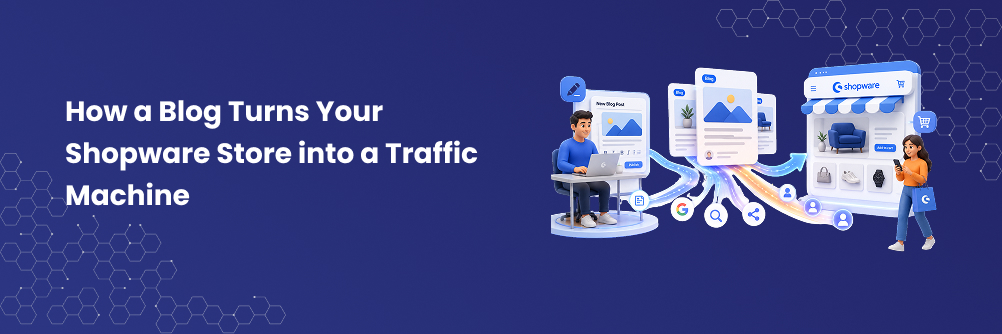
Powered by Content.
Ecommerce stopped being just about great product pages and competitive pricing a long time ago. The webshops that grow consistently are the ones that deliver value to their visitors beyond the checkout process. And in that, content specifically a well-maintained blog plays a leading role.
Yet most Shopware store owners treat their blog as an afterthought. They post something occasionally, without strategy, without consistency, and without measurable goals. The result: a blog that delivers nothing.
That's a waste. Because a blog used strategically is one of the most cost-efficient marketing channels available to any online store. Let's look at exactly why and what it takes to get it right.
Why a Blog is Essential for Your Shopware Store
According to Orbit Media's 2025 Blogger Survey, marketers who publish long-form, original content consistently report the strongest results. SEO leads close at 14.6% compared to just 1.7% for outbound leads making a content-driven blog one of the most efficient lead sources available.
But that's just the beginning. Blogs have something paid advertising doesn't: compound effect. An article you write today can still generate traffic six months from now without spending another penny. Ads stop the moment you stop paying. A well-written article keeps working for you, month after month, year after year.
What a Blog Delivers for Your Shopware Store
Well-optimised blog posts rank in search engines and keep generating traffic sometimes for years. Every new post is an additional entry point for visitors who haven't yet discovered your store.
As your blog archive grows, the pressure on paid advertising decreases. Content is an investment that increases in value. Ad spend is a cost that evaporates the moment you stop paying.
Visitors are more likely to buy from a shop that demonstrably knows its subject. A blog that answers your audience's real questions builds trust before anyone has clicked "Add to Cart."
Blog content that links to product pages, categories, and other pages strengthens your entire site in the eyes of search engines. Every internal link is a trust signal and a navigation pathway.
A blog gives people a reason to come back, even when they're not ready to buy. Returning visitors already have familiarity and warmth they convert at significantly higher rates than cold traffic.
AI assistants like ChatGPT, Google AI Overviews, and Perplexity increasingly cite well-structured content. A strong blog makes your store visible in AI-generated answers a rapidly growing traffic source.
The New Dual-Channel: SEO and GEO
Discoverability in 2026 is no longer just about Google rankings. A new channel has emerged that your blog content is uniquely positioned to capture: Generative Engine Optimization (GEO).
- Rank in Google, Bing, and other search engines
- Drive organic clicks from search results pages
- Target specific keyword queries with long-form content
- Build domain authority through consistent publishing
- Capture intent-driven traffic at every stage of the funnel
- Get cited in ChatGPT, Google AI Overviews, and Perplexity
- Appear in AI-generated answers to product questions
- Build structured, authoritative content AI systems trust
- Reach users who never click traditional search results
- Compound authority across both human and AI audiences
What Makes a Shopware Blog Actually Effective?
An effective ecommerce blog does more than publish text. The best webshop blogs are visually consistent with the brand, technically clean for search engines, and structured to guide readers toward products and purchases not just inform them and let them leave.
Useful, in-depth content performs better in both search engines and AI tools. Answer the real questions your customers have the ones they ask before buying, during consideration, and after purchase. Thin content optimised purely for keywords fails in both SEO and GEO.
Use clear H2/H3 headings, categories, and tags so visitors and search engines understand your content immediately. Structure also helps AI systems parse and cite your content accurately. A well-structured article is a trust signal for everyone who reads it human or machine.
One quality article every two weeks outperforms three articles per week that trail off halfway through the year. Search engines reward consistent publishing signals. Your audience rewards reliable value. Set a cadence you can sustain indefinitely and protect it.
Blog content that links to specific products, category pages, and related content strengthens your entire site not just the blog. Every internal link reinforces page authority, creates navigation pathways, and subtly guides readers toward purchase. Never let a blog post be a dead end.
A blog that looks visually disconnected from your storefront destroys trust. Shoppers notice design inconsistency and associate it with a lack of professionalism. Your blog should feel like a natural extension of your store same typography, same colour palette, same quality.
Blogging in Shopware 6 What You Need to Know
Here's something Shopware doesn't advertise prominently: Shopware 6 doesn't include a built-in blog. The platform's architecture is flexible enough to solve this with a plugin, but you need to choose the right tool and set it up correctly to get the full SEO and GEO benefit.
The good news: Shopware's Shopping Experiences CMS the same drag-and-drop builder you use for your homepage and landing pages can power your blog detail pages and overview pages too. This means your blog can look and feel exactly like the rest of your store, built with the same layout tools you already know.
Where to Start Three Questions That Define Everything
Setting up a blog strategy sounds like a big project. It starts much simpler than most store owners expect. Answer these three questions and you have the foundation for a content calendar:
Use Google Search Console, Ahrefs, or a keyword tool to find the specific questions your potential customers type before they buy. These become your article topics.
Find topics where demand is high, but good content is scarce. These are the fastest routes to ranking and the areas where your expertise can dominate quickly.
One quality article every two weeks beats three per week that trail off by March. Set a publishing cadence you can protect, and commit to it as a business priority not an afterthought.
We select, install, and configure the right blog plugin for your Shopware store from basic setups to fully custom solutions built inside Shopping Experiences. Every configuration is tuned for performance, SEO, and your content workflow.
We design your blog detail pages, overview pages, and category views to match your storefront exactly same fonts, same colour palette, same layout quality. Your blog should feel like a natural extension of your store, not a plugin add-on.
Clean URL structures, auto-generated sitemaps, meta title and description templates, canonical tags, structured data markup, Open Graph tags every technical SEO element configured correctly at launch, not as an afterthought.
We research your audience, analyse search demand, identify your content opportunities, and deliver a 3–6 month content calendar with topic briefs, keyword targets, and publishing cadence. Strategy before a single word is written.
We integrate AI content tools into your Shopware blogging workflow enabling AI-assisted drafting, title generation, and tone-consistent content at scale. You stay in full editorial control; AI accelerates your publishing velocity dramatically.
We monitor your blog's performance tracking rankings, engagement, and conversion impact and make iterative improvements each month. Content is a living system, not a one-time project. Our retainer support keeps it compounding.
Frequently Asked Questions
Does Shopware 6 have a built-in blog feature?
No. Shopware 6 does not include native blog functionality. You need a plugin to add a blog to your Shopware store. The good news is that Shopware's Shopping Experiences CMS can power blog page layouts, meaning your blog can be visually consistent with the rest of your store. Mavenbird selects, configures, and customises the right blog solution for your specific store.
How much traffic can a Shopware blog realistically generate?
This depends on your niche, publishing consistency, and content quality but a well-executed blog strategy typically generates measurable organic traffic increases within 3–6 months, with significant compound growth from month 6–24. Stores that publish 2–4 quality articles per month consistently report 30–60% of their organic traffic coming from blog content within 18 months. Mavenbird tracks and reports these metrics monthly.
What is GEO and why does it matter for my Shopware store?
GEO (Generative Engine Optimisation) is the practice of creating content structured to appear in AI-generated answers from tools like ChatGPT, Google AI Overviews, and Perplexity. As more shoppers use AI assistants to research purchases, stores whose blog content gets cited in AI responses gain a new organic traffic source. Well-structured, authoritative blog content is the foundation of both SEO and GEO they require the same investment.
How long does it take to see results from blogging?
Content SEO is not instant, but it's not as slow as many store owners fear. Initial traffic movements typically appear in 6–12 weeks for low-competition topics. Competitive keywords take 3–6 months to rank meaningfully. The compound effect where your growing archive generates increasing traffic without additional work becomes clearly visible around the 6–12 month mark. This is why starting sooner is always better than starting later.
Can Mavenbird write blog content for my Shopware store?
Yes. Mavenbird offers full content strategy and production services from keyword research and content planning to AI-assisted drafting, editorial review, and publishing. We can handle the entire content workflow or provide specific support at any point in your process. Contact our team to discuss what level of support makes sense for your store and budget.
Ready to turn your Shopware store into a traffic machine?
Mavenbird sets up your blog correctly from day one technically sound, brand-consistent, SEO-ready, and connected to your conversion funnel. Let's build something that compounds in your favour.